
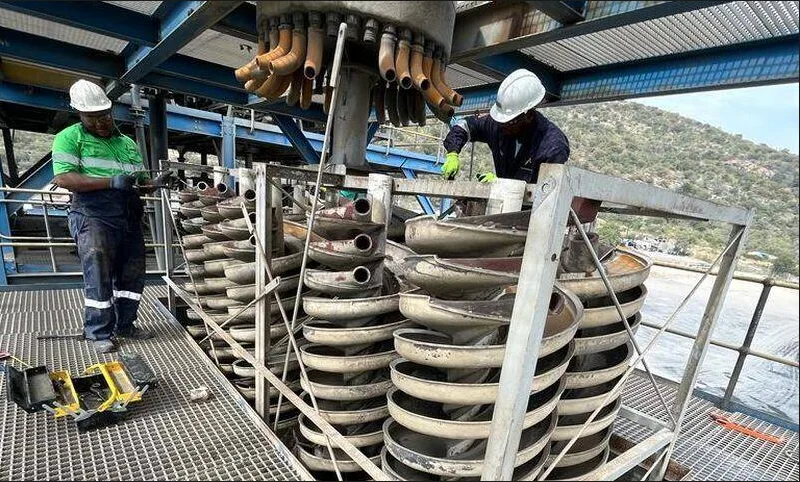
Every concentrator has a recovery figure, and whatever that figure falls short of 100% ends up on the tailings facility. A chrome spiral plant recovering 70% of the chromite in its feed sends the other 30% to the dam. Over twenty or thirty years of operation, a tailings facility can build up a large inventory of valuable minerals that has already been mined, crushed and milled at someone else's expense.
South Africa has a long history of going back for that material. Gold has been recovered from Witwatersrand sand and slimes dams for decades. On the Bushveld Complex, chromite is recovered from the tailings of PGM concentrators treating UG2 ore, and PGMs are in turn recovered from the tailings of chrome beneficiation plants. Coal fines and discard dumps have also been reprocessed where coal quality and prices justify it. Tailings retreatment is therefore an established practice, not a new idea. What decides whether a particular deposit is worth treating is how well the material is understood and whether the plant is designed for what is actually in the dam.
Why valuable minerals end up in tailings
Before asking whether tailings can be retreated, it is worth asking why the value was lost in the first place, because the cause of the loss determines what a second pass can realistically recover.
The most common cause is particle size. Gravity separation equipment such as spirals works well in roughly the 75 µm to 1 mm range, but efficiency drops sharply on finer material. Chromite is brittle and produces a lot of fines during crushing and milling, and much of that fine chromite reports to the tails. The same applies to fine heavy minerals in mineral sands operations and to fine coal.
The second cause is incomplete liberation. A grain of chromite or a PGM bearing sulphide that is still locked with silicate gangue in a composite particle does not behave like the free mineral. In a spiral it has the wrong effective density, and in a flotation cell it does not present enough exposed surface to the collector. Locked value will not be recovered by simply reprocessing the material as it is; it normally needs regrinding first.
The third cause is operational. Overloaded spirals, unstable feed density, worn spiral troughs, unevenly split distributors and badly set product splitters all push recoverable mineral into the tailings stream. Losses of this kind are often the easiest to recover, because a correctly operated conventional circuit can capture them.
Finally, there is history. Many older dams were deposited when commodity prices were lower, cutoff grades were higher, or the technology to recover a particular mineral was not yet in use. Recovering PGMs from chrome tailings, for example, only became widespread in the 2000s.
Start with proper characterisation
Tailings are rarely homogeneous. When slurry is deposited from spigots or cyclones, the coarser and denser particles settle close to the discharge points and the outer walls, while the fines travel further towards the pool. Grade also changes with depth, reflecting changes in ore source, plant performance and operating practice over the life of the original mine. A handful of grab samples taken from the surface can therefore give a badly misleading picture. A reliable resource estimate usually needs a grid of auger or sonic drill holes, sampled at regular intervals down each hole, so that the tonnage and grade can be modelled across the whole facility.
The test work programme that follows typically includes:
- Particle size distribution with chemical assays per size fraction, to show where the value actually sits. If most of the chromite or gold is in the finest fraction, the flowsheet choice changes completely.
- Chemical analysis of the relevant elements, for example Cr2O3, SiO2 and FeO for chrome tailings, 4E or 6E PGM grades for UG2 material, or gold and sulphur for Witwatersrand tailings.
- Mineralogical analysis, usually by automated scanning electron microscopy (QEMSCAN or MLA), to measure liberation and identify which minerals the valuable phase is associated with.
- Heavy liquid separation and laboratory spiral or shaking table tests to establish gravity amenability, and bench flotation tests where sulphides or PGMs are the target.
- Physical properties such as moisture content, specific gravity, slimes and clay content, and the degree of oxidation. Sulphides in older dams oxidise over time, which can seriously reduce their flotation response.
For larger projects, a pilot plant campaign is worth the cost. It confirms recoveries and grades at a meaningful scale, generates concentrate for offtake testing, and exposes practical problems such as screen blinding or pump wear before the full plant is built.
What a typical retreatment flowsheet looks like
No two plants are identical, but most retreatment circuits follow the same broad sequence.
Reclamation
Slimes dams are commonly reclaimed hydraulically, using high pressure monitor guns to break down the deposit and wash it into a sump as a slurry. Drier or coarser deposits are often reclaimed mechanically with excavators and front end loaders and then repulped. In both cases the slurry is screened to remove trash such as roots, plastic and rock before it is pumped to the plant.
Feed preparation
Hydrocyclones are used to classify the feed and remove slimes. Desliming is important for gravity circuits because ultrafine particles raise the viscosity of the pulp and report unselectively to the concentrate, diluting grade. Where mineralogy shows that the value is locked, the coarse fraction may be reground to improve liberation before concentration.
Concentration
For chromite, mineral sands and other heavy minerals, spirals are the workhorse, usually in rougher, cleaner and sometimes recleaner stages. Spiral performance depends heavily on a few controllable variables: solids feed rate per start, pulp density (typically somewhere between about 25 and 40% solids by mass, depending on the material and spiral type) and the position of the product splitters. Even distribution of feed is just as important. A distributor that splits the flow unevenly overloads some starts and starves others, and the plant loses both grade and recovery without any obvious sign on the surface. For chrome tailings, the target is usually a metallurgical grade concentrate of roughly 40% Cr2O3 or higher, or a chemical grade product of about 46% Cr2O3 with low SiO2.
Where the target is a sulphide, PGMs or very fine material, flotation is normally used, often after a regrind stage. Gold tailings are usually treated by cyanide leaching in a carbon in leach (CIL) or carbon in pulp (CIP) circuit, sometimes after flotation to produce a sulphide concentrate.
Dewatering and residue disposal
Concentrates are dewatered on screens, in drainage stockpiles or by filtration, depending on the product specification. The final tailings are usually thickened to recover process water before being deposited on a residue facility. That facility must be designed and operated to current standards: in South Africa, residue deposits are regulated under the National Environmental Management: Waste Act, and many operators have also committed to the Global Industry Standard on Tailings Management (GISTM).
The case for retreatment
The strongest economic argument is that the expensive work has already been done. The material has been mined, hauled, crushed and milled, and comminution is normally the largest single consumer of energy in a concentrator. Apart from any regrinding, a retreatment plant avoids most of that cost. Because the resource sits on surface and has a known history, a retreatment project can also be brought into production much faster than a new mine.
There can be environmental benefits as well. Several old, poorly engineered dams can be consolidated onto a single modern facility, freeing land for rehabilitation. Removing pyrite during retreatment can reduce the potential of the remaining residue to generate acid mine drainage. These benefits are not automatic, however. The new residue still has to be managed, and a poorly run retreatment operation can create its own dust, water and stability problems.
The limitations
Retreatment is not easy money. Head grades are low, and the particles that were easiest to recover have already been removed, so recoveries are usually lower than in the original plant. The feed is fine, variable and abrasive, which means high wear on pumps, pipelines, cyclones and spirals. Water supply can be a constraint, particularly where slimes have to be reclaimed hydraulically. In South Africa, the legal right to reprocess the material also needs to be clear before any money is spent, because ownership of historical residue deposits can be complicated.
Where engineering makes the difference
Many retreatment plants that underperform do so because of practical engineering details rather than the flowsheet itself. Slurry pumps need to be selected for the actual specific gravity and particle size of the slurry, not a nominal value. Pipelines must run above the deposition velocity so that solids do not settle and block the line, but not so fast that wear becomes excessive. HDPE pipe performs well in these duties because of its abrasion resistance. Launders need enough slope to carry dense, coarse solids without sanding up. Sampling points must be designed into the plant from the start, because without reliable feed, concentrate and tailings samples the metallurgical accounting, and therefore the mass balance, cannot be trusted.
Commissioning should be done in stages: water first to check flows and leaks, then slurry at reduced throughput, then a controlled ramp up while splitter positions and feed densities are optimised. Once the plant is running, regular shift sampling and online density measurement allow the metallurgist to track mass yield, concentrate grade and recovery, and to pick up problems early.
Makurung Process Solutions and tailings retreatment
Makurung Process Solutions has been providing processing and engineering solutions to the mining industry since 2017. The company designs, constructs, maintains and optimises spiral plants, provides flotation maintenance and optimisation, and supplies, fabricates and installs HDPE piping, working across coal, chrome, PGM, iron ore and mineral sands operations.
Makurung's recent work includes a 40 t/h tailings retreatment plant, where the scope covered plant inspection, installation of the spiral concentrators, the distributor system, piping and launder integration, and commissioning through to handover to the client. It is exactly the type of project where the details discussed above, from even feed distribution to correctly sloped launders, decide whether the plant meets its design recovery.
Is tailings retreatment right for your operation?
Before committing to a retreatment project, an operation should be able to answer the following questions with test work data rather than assumptions:
- How many tonnes are available, at what grade, and how does the grade vary across and down the deposit?
- In which size fractions is the value, and how well liberated is it?
- Which process route achieves a saleable concentrate, and at what recovery?
- What will reclamation, processing, water, power and residue disposal cost per tonne treated?
- Are the legal rights to the material and the environmental authorisations in place?
- Does the project remain viable at conservative commodity prices?
A structured programme of sampling, test work and a feasibility study is the only reliable way to answer these questions. Where the answers are positive, tailings retreatment can turn a long term liability into a productive resource.
To discuss a tailings retreatment project or the performance of an existing spiral or flotation plant, contact Makurung Process Solutions.
Contact: +27 15 280 0243
Email: info@makurung.co.za